


A Nov. 18 immigration raid in St. Paul may have offered a preview of what is to come in the Twin Cities, immigrants’ advocates say.
And, they add, it showed them that they’re ready to respond.
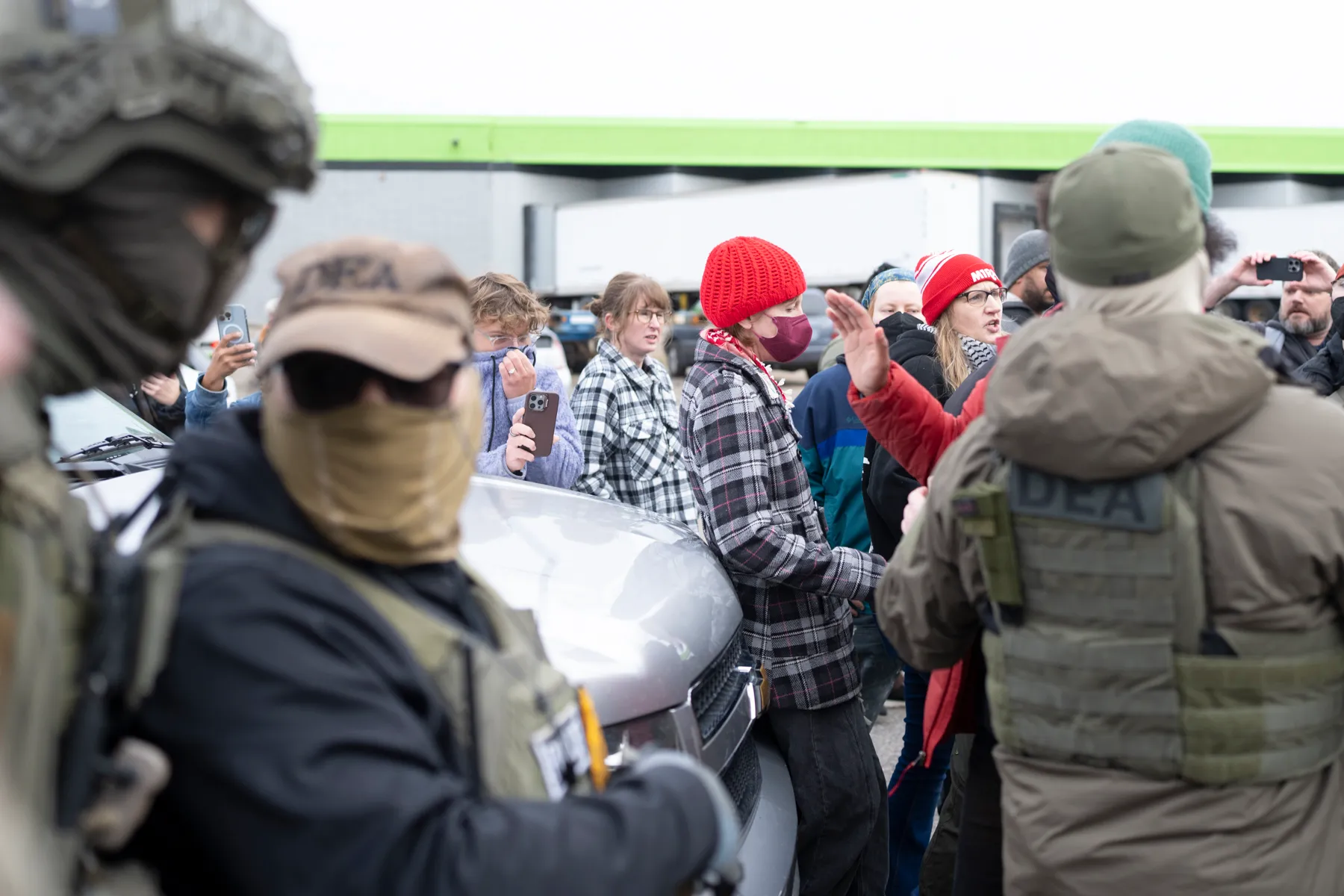
That morning, protesters clashed with federal agents conducting an immigration enforcement action at St. Paul wiper manufacturer and distributor Bro-Tex. At least 14 people were arrested. Officers from several agencies, including the FBI, Immigration and Customs Enforcement (ICE) and Homeland Security Investigations (HSI) fired pepper balls at protesters blocking vehicles.
Many of the protesters had arrived just minutes after the agents. That swift response was the result of a coordinated effort to mobilize individuals to such scenes. A carefully organized system of information gathering and dissemination alerted them to the operation and instructed them on how to respond.
For local immigrant rights groups, the swift response was a moment long in the making.
Edwin Torres Desantiago, of COPAL, speaks on November 19, 2025, during a vigil the day after a raid by federal agents. Credit: Aaron Nesheim | Sahan Journal
Laying the groundwork for resistance
For Edwin Torres Desantiago, the fight for immigrant rights is personal. Torres Desantiago, who is originally from El Salvador, became the first undocumented immigrant and Deferred Action for Childhood Arrivals (DACA) recipient admitted to the Ph.D. program at the University of Minnesota’s Hubert H. Humphrey School of Public Affairs. He has also established himself as a community organizer and immigrant rights leader in the Twin Cities.
After President Donald Trump’s reelection in November, advocates across the state realized it was necessary to prepare for increased targeting of immigrant communities, Torres Desantiago said.
“We knew that this time they would be prepared,” he said.
In response, the Immigrant Defense Network (IDN) was born.
Immediately following the 2024 presidential election, the community advocacy group Communities Organizing Latine Power and Action (COPAL) reached out to partners to strengthen ties. Those discussions led to the formation of the IDN, which has expanded to include more than 100 immigrant, labor, legal, faith and community organizations dedicated to advancing the constitutional rights of Minnesota’s immigrant communities.
“Our network spans multiple counties across the state of Minnesota,” Torres Desantiago said. “We now have this collective of organizations and leaders that can give us information on what’s happening in real time.”
The IDN has built infrastructure that responds rapidly to immigration enforcement operations throughout the state. It allows the IDN to verify information and deploy individuals trained in its constitutional observer program. These observers are the first responders to ICE and other immigration enforcement actions, trained by IDN partner organizations to exercise their legal rights when documenting federal agents in public.
Other advocacy organizations are conducting trainings as well. Since December 2024, Minnesota Immigrant Rights Action Committee (MIRAC) has offered monthly ICE raid response trainings, teaching anywhere from 100 to 200 participants per session, according to organizer Dieu Do.
Last week, these preparations were put to the test.
Over 100 community members gathered for a vigil on November 19, 2025, at Bro-Tex Inc., where a federal raid took place the previous day. Credit: Aaron Nesheim | Sahan Journal
Mobilizing on the ground
At 8 a.m. on Nov. 18, federal agents launched immigration enforcement operations at Bro-Tex. Within minutes, the first constitutional observers had arrived on the scene. By 9:45 a.m., 40 people had shown up.
The IDN had been on high alert in the wake of large-scale operations in other U.S. cities. To prepare, it had established a campaign called Adopt a Corner to protect high-risk areas and send out alerts.
“People are going to be documenting, they’re going to be verbally upholding civil rights, they’re going to be asking if ICE is on the scene that they’re presenting the proper warrants and documentation,” said Ryan Perez, COPAL’s organizing director. “They’re just upholding people’s civil rights all around.”
Adopt a Corner debuted in Los Angeles in response to ICE raids. As federal agents increasingly targeted locations frequented by immigrant workers and residents, such as grocery stores, car washes and hardware stores, volunteers “adopted” those locations and documented immigration enforcement activities there. Following its success in Los Angeles, the campaign has moved to Minnesota.
That preparation proved essential during the St. Paul raid. Perez said he was immediately alerted to it by activist partners.
“I got the call from three different sources within five minutes,” he said.
Torres Desantiago said constitutional observers were at the Bro-Tex facility within 12 minutes of the alert about the raid.
“For many, we became the most reliable source of information,” he said. “We were sharing even with local agencies, because we were on the ground.”
When verified information about immigration enforcement reaches the IDN, the network methodically disseminates it. A Signal chat with every trained constitutional observer in the network and organization leadership is activated. Alerts are sent to partner organizations, which then alert their own email databases, allowing the news to spread beyond the IDN’s immediate network.
“We’ve been very intentional about the extent to which everyone gets notified,” Torres Desantiago said. “We’ve created a layered, staggered approach to disseminating information.”
Documenting ICE actions is only the first layer in the IDN’s response. Once constitutional observers record immigration enforcement, that information is passed on to the network’s legal partners, who can use it to craft immigrants’ legal defense.
“The biggest thing is, do you have all the tools that after the fact, can you connect families with resources, were you able to capture anything on camera that can be helpful for our legal partners,” Perez said. “That’s all of what we’re training and preparing for.”
Perez said the Nov. 18 IDN response proved that the Twin Cities can offer meaningful resistance to immigration enforcement.
“This was a situation where we had trained observers that were successfully deployed, made it to the communities, started documenting and connected with the impacted families,” Perez said. “It really goes to show that you have trained people that know how to respond, connect family with resources, it’s a successful model of organizing.”
Ryan Perez, Organizing Director of COPAL, speaks at a vigil on November 19, 2025, outside of Bro-Tex Inc., where a raid by federal agents took place the previous day. Credit: Aaron Nesheim | Sahan Journal
Lessons learned
In the aftermath of Nov. 18’s events, the IDN is looking at what can be improved in the future.
“We’re going to see more and more of these big enforcements,” Perez said. “We need to be extremely well organized.”
Since June, the Trump administration has deployed the National Guard to multiple cities, including Los Angeles; Washington, D.C.; Memphis, Tennessee, and Portland, Oregon, to back up immigration enforcers. Torres Desantiago said Minnesota organizers can learn from those places.
“We’re in talks with Chicago allies, Oregon partners, Los Angeles, about what has gone well in their rapid response systems and what are things they wish they would have figured out before the National Guard came into their streets,” Torres Desantiago said.
To better prepare its own response strategy, the IDN sent a leadership delegation to Los Angeles to be trained by the National Day Laborer Organizing Network on how to adapt their Adopt a Corner model, Torres Desantiago said. In addition, members from the Center for Popular Democracy will soon come to Minnesota for two days of training with IDN.
Despite such assistance, IDN will have to tailor its response to the needs of Minnesota, Torres Desantiago said. He said that right now, the most pressing local need is for more volunteers.
“We need more people trained,” Torres Desantiago said. “We have about 2,000 people all over the state, but we need 10,000 people minimum to make sure we have enough capacity.”
Balancing the moment
As the likelihood of future immigration enforcement operations in the Twin Cities grows, organizers recognize that preparing communities to exercise their rights has to take into account that it occurs in a time when fear is strong.
“It’s a balance to strike, making sure people have the information they need to protect themselves and their families, and also not panicking,” Do said.
Having lived in the United States as an undocumented immigrant, Torres Desantiago is well aware of the stress immigrant communities are under.
“We first have to be grounded that the work we do is emotionally taxing,” he said. “We know that our job here is not to incite fear, it’s not to plaster every single time there is an ICE operation, because we are then retriggering our communities and continuing this cycle of fear.”
At a vigil organized by IDN the day after last week’s raid, candles were lit in honor of those arrested by federal agents. Several community organization leaders and politicians, among them St. Paul mayor-elect Kaohly Vang Her, spoke to a crowd of more than 200 people. Her said the city is just beginning to build its rapid response capacity to such actions.
“The federal administration benefits when we are confused, divided and unsure of what actually is happening on our streets,” Her said. “This is exactly the kind of situation where a rapid response communication system would have helped. There is much we need to do in our city in creating this network and this infrastructure.”